Adventist Media Response and Conversation

Saturday, September 11, 2021

Politics seems to color everything Adventist Today publishes


By Ron Corson

Once again we see Adventist Today wallowing in their political leftists views.  They really should change the name of the site to Leftist Thoughts for Adventists. The latest article from Jack Hoehn entitled ComeAndReason.com Seems Unreasonable on COVID  The article’s third paragraph reads:

Anti-vaccination Views

That is why his political views now infusing health issues are so distressing. In the past he has come out in support of the twice-impeached past American president’s policies both on his Christian website and in an article published on the Spectrum website February 3, 2020.

That is interesting how the political left has forgotten that it was the Trump Administration that fast tracked the vaccine creation and production.  But now Trump is just that twice-impeached President, even though he was never convicted of any offense by the Senate which is needed to really complete an impeachment of a president. But now to the left Trump is synonymous with Anti-vaccination views. Interestingly Donald Trump had the COVID-19 virus and who was also vaccinated. Facts that in the world of insinuation have no place it appears.

The next paragraph is equally as silly:

Now Jennings focuses on masks, vaccines, and what he considers the threat of “mandates.” He calls the most-studied vaccines in the long history of vaccination “experimental injections,” as if this were some sort of isolated lab study instead of a crisis response to a death-dealing pandemic.

Let’s begin with the clearly false statement that the COVID-19 vaccines are the most studied vaccines in history.  It has not even been out for 2 years, we have no studies on the long-term effect or even the 5-year effect of the vaccines. It is impossible to believe anyone thinks it is the most studied vaccine in history but you see that is what Dr. Hoehn who was actually at one time a doctor thinks!

Why Hoehn is not equally concerned with mandates is peculiar since even President Biden and his Spokesperson have said that they would never do mandates. Kind of something that anyone with any regard for our Republic should be concerned with.  Of course, there is a fear side to a lot of leftists who feel that individual rights have no place when the world is in a pandemic condition even though the case fatality rates is pretty much less than 1% for those below 60 and does not rise to above 4% until the age of 70. So yes it is a death-dealing disease just like every other disease in the world. See the chart at https://ourworldindata.org/mortality-risk-covid#interpreting-the-case-fatality-rate

I will not bother to argue support or data against Dr. Hoehn’s position or Dr. Jennings position as that much more complex a subject and really there is nothing to Dr. Hoehn’s position he simply implies that Dr. Jennings is wrong by appealing to organizations. That, by the way, is not really how science works and that appears to be one of the key points to Dr. Jennings argument, pretending that science is a consensus business instead of a questioning endeavor.

Toward the end Hoehn states:

Only the last three on the list are not dangerous with possible serious side effects, and all have proven to be largely ineffective in preventing death or long-term disability from COVID-19. All have had their proponents, Petri dish or theoretical suggestions, and all have been tested in real life. There are now very few politically unmotivated supporters of any of those drugs. Dr. Jennings denies political motivation, but when you are agreeing mostly with QAnon conspiracists and irrational pillow salesmen, one gets a bit anxious.

Here we see again that Hoehn feels this is all political and indeed it is to him. I am sure that Jennings article mentions nothing about QAnon or Michael J. Lindell is the inventor and CEO of My Pillow, Inc. famously a supporter of Donald Trump. He is also a well-known Christian whose testimony from drug addict to successful businessman seems to make him one of the enemies of the political left. We can look at Dr. Jennings article here, something that Hoehn did not link to in his article or really even quote Dr. Jennings. Funny how that works isn’t it, a electronic publication that can’t even link to the article it is criticizing. That is a good indication that you are not dealing with an honest journalistic endeavor.

That is the saddest point in all this. I don’t really care that people have different views on the vaccine or masks. I care a lot more that the Adventist Church is becoming the playground of political progressives who have no interest in even dealing with other views and actively removes those who disagree with them from their pages.  I care most about people who are ignoring government over-reach by the state and Federal government claiming an emergency. No doubt the next emergency will be climate change which will likely be far more over-reaching than this pandemic but if there is no push back against government mandates now it will be far harder in the future.


Thursday, July 08, 2021

Christians must not disagree or world will reject Christians


I am often amazed at the things I read on Adventist Today. I don’t mean amazed in a good way but amazed at the poorly reasoned statements that are included in the articles. I am equally amazed that on Adventist Today’s Facebook comment page none of those good SDA’s even notice the absurd statements.  I suppose since they have purged most people who ever criticize or offer counter opinions to their articles they are left with not the brightest population to offer their comments but occasionally someone gets in there with a good comment.


In the article, Ecumenism Is Not a Bad Word Clarence Pamphile writes in his article of 27 June 2021 this statement:

“Christian unity is inevitable. It is of Christ’s and of God’s imposing, and that, for a reason: the world will not believe while Christians are criticizing, accusing, or denouncing one another.

Really Christian perfection is inevitable, the world will not believe while Christians don’t get along with each other perfectly. The world which at one time was changed by Christians even when they denounced other Christians and their beliefs or actions can do that no longer. The Adventist church can’t get along within itself. Maybe the SDA church should avoid dealing with other denominations until we are all in agreement. It is an absurd statement.  Now Christian unity may one day be inevitable likely after the second coming and then it will be God’s imposing but this idea that we must all get along now with no disagreement before the world can recognize God is placing too much responsibility on humans. I guess it would give the world a really good excuse to reject Christians and Christianity however. So if the goal is to promote Atheism then the statement might have a bit of power. But as a method to spread Christianity, it is worthless.


Saturday, June 26, 2021

Olive Hemmings distortion of the beloved disciple


Adventist Today writer Olive Hemmings  Presents a rather peculiar view of the “beloved disciple” here is what she says in the excerpt of her article and presentation


Tradition

The idea that John the son of Zebedee is the beloved disciple is based on tradition. The internal Biblical evidence points elsewhere to the “beloved disciple”. The entire investigation about this disciple requires a hermeneutic of suspicion.

This is what we have to show that John is the “beloved disciple”.

In John 21: 20, ff., Peter turns and sees the disciple whom Jesus loves following them. The text says that it is this disciple who reclined next to Jesus and enquired about who would betray him. Peter sees him and continues to interrogate Jesus concerning this disciple. Then the author of the Fourth Gospel says: “This is the disciple who is testifying to these things and has written them, and we know that his testimony is true.” The assumption is that John wrote the Fourth Gospel, therefore John is the beloved disciple.

But in fact we do not know who wrote the Fourth Gospel. Even the commentary saying: “This is the disciple who is testifying to these things…” appears as a comment by the actual author about the ‘beloved disciple”. This suggests that the beloved disciple, an eye witness, was the source of the author’s work.

Dr.Olive Hemmings presentation at the zoom Sabbath School took the position That the beloved disciple was Mary Magdalene. Due to the use of some extra-Biblical works namely Gospel of Thomas, and the Gospel of Mary Magdalene. In order to use those books for her theory (the same theory that you can read about in Dan Brown’s the Da Vinci Code) Ms. Hemmings assumes that we can discount the tradition of the author of the book of John as actually being John. Which in fact may be the case and yet it would not negate the meaning that John was the beloved disciple in any way. So there is very little reason to entertain the idea of Mary Magdalene being the meaning of the beloved disciple in the book of John

 Contrary to Dr. Hemmings statement above, in fact, this is not the only thing we know to give us an idea of who the beloved disciple was. There are 6 references in the book of John:

1.     John 13:23: “One of them, the disciple whom Jesus loved, was reclining next to him.”

2.     John 19:26: “When Jesus saw his mother there, and the disciple whom he loved standing nearby, he said to her, ‘Woman, here is your son.’”

3.     John 20:2: “So she came running to Simon Peter and the other disciple, the one Jesus loved, and said, ‘They have taken the Lord out of the tomb, and we don’t know where they have put him!’”

4.     John 21:7: “Then the disciple whom Jesus loved said to Peter, ‘It is the Lord!’”

5.     John 20:20: “Peter turned and saw that the disciple whom Jesus loved was following them.”

In addition to this, John 21:24 describes the Beloved Disciple as the “disciple who testifies to these things and who wrote them down.” 

https://zondervanacademic.com/blog/who-wrote-the-gospel-of-john

By the internal evidence of the book of John we can rule out the beloved disciple as being Mary Magdalene Using John 20: 1-4:

20 Early on the first day of the week, while it was still dark, Mary Magdalene went to the tomb and saw that the stone had been removed from the entrance. 2 So she came running to Simon Peter and the other disciple, the one Jesus loved, and said, “They have taken the Lord out of the tomb, and we don’t know where they have put him!” 3 So Peter and the other disciple started for the tomb. 4 Both were running, but the other disciple outran Peter and reached the tomb first.

Thus Mary Magdalene could not be the person referred to in the book of John as the beloved because she in fact speaks to that person. Then after Mary Magdalene having run from the tomb, if she was the beloved she would have had to run back to the tomb beating Peter.

Let’s look at Dr. Olive Hemmings Biography

Olive Hemmings has been teaching in Seventh-day Adventist higher education since 1982. She began teaching at her Alma Mater West Indies College (now Northern Caribbean University) in 1982, one year before graduating, and continued teaching there until 1998, when she moved to California to further her studies. She earned the M.A. in New Testament and Biblical languages from the SDA Theological Seminary at Andrews University in 1989, and the Ph. D. in Theology, Ethics, and Culture from Claremont Graduate University in 2004. She taught at Northern Caribbean University for 15 years, and has been teaching at Washington Adventist University for the past eleven years in the areas of New Testament Bible and Greek, World Religions, Social, Biblical, and Theological Ethics, and Dogmatic Theology both in graduate and undergraduate programs.

It might be interesting to know how Dr. Hemmings arrived at this decision to support the idea that Mary Magdalene was the beloved disciple.  Perhaps if a person watches the Adventist Today YouTube presentation when it posts they can see. Check for it in the future.

 On a related note, when people view the presentation they will see that Dr. Hemmings trys to discount the notion that the gospel of Thomas is a gnostic work. But as you can see in my opening quote of Dr. Hemmings she says: 

"The entire investigation about this disciple requires a hermeneutic of suspicion."

Here is the definition of hermeneutic of suspicion which to me sounds like gnostic reasoning. 

"The hermeneutics of suspicion is a style of literary interpretation in which texts are read with skepticism in order to expose their purported repressed or hidden meanings.[1]

This mode of interpretation, invented by Paul Ricoeur, who was inspired by his interpretation of the works of what he called the three "masters of suspicion"[2]Karl MarxSigmund Freud, and Friedrich Nietzsche— Ricoeur's term "school of suspicion" (Frenchécole du soupçon) refers to his association of his theory with the writings of the three, who themselves never used this term.[3] This school is defined by a belief that the straight-forward appearances of texts are deceptive and that explicit content hide deeper meanings or implications.[1][4] 

 In reference to the last post I made this may reflect what is going on with Dr. Hemmings. 

The Gospel of Thomas has become popular in recent decades in relation to a populist Christian movement known as Liberation Theology, which also teaches self-reflection of each person as the Christ within you. Gustavo Gutierrez coined the term in his 1971 CE book, A Theology of Liberation. He criticized the Catholic Church in Latin America for corrupting the original teachings of Jesus.  Jesus. https://brewminate.com/secret-knowledge-a-history-of-christian-gnosticism-in-the-ancient-world/


Sunday, June 20, 2021

Alex Bryan pseudo-intellectual nonsense

 Alex Bryan Posted on Facebook:

I have come to the position that Christians must let Jesus go.

Why? The only possible solution to our insurmountable global, political problems must include two elements. First, the solution must truly include every individual human being: if any one person or group is left out there cannot be success. Second, the solution must pull every one together. Individualistic libertarianism for all won’t get it done – “live and let live” is a philosophy that eventually kills community.

The solution, therefore, must “hold ALL things TOGETHER.”

Paul’s Colossians 1:15-20 proffer to us: Jesus does this.

Religious sectarianism fails this test. Secular humanism fails this test. Globalism, nationalism, conservatism, liberalism– they all prove inadequate.

Only Jesus will do. But for “Jesus” to work Christians must let him go. We cannot claim him as ours and not yours. We cannot proclaim him as the private possession of Christendom. We cannot use him for our own tribalistic dreams.

He’s always asked for this – “I have to leave now for I have other towns” … “Remember, I have other sheepfolds” … “Mary, you can’t hold on to me” … “God in a Single Human Body must leave so the Spirit of God can blow all over the earth.”

The monotheistic message of Jesus – there is only One God, and all are God’s children, together. This message transcends all religion, all culture, all party, all tribe, all nations.

Transcendence.

And so we have to let Jesus go, and at the very same time, remain.

https://www.facebook.com/alex.bryan.393/posts/10158998077086072?


Oh, how I hate this kind of pseudo-intellectual nonsense!  First, how does he define letting Jesus go?  He does not yet that is his opening and closing line! Second, he says Christians cannot claim Jesus as ours or yours. Yet very clearly that is the Biblical and Christian tradition. "John 20:17 Jesus said, “Do not hold on to me, for I have not yet returned to the Father. Go instead to my brothers and tell them, ‘I am returning to my Father and your Father, to my God and your God.’ ” My Father AND your Father – my God and your God." This pastor even uses the first part of that text in his message. You can't ignore the whole Bible to follow foolish pastors! 

"Deuteronomy 6:5 You shall love the Lord your God with all your heart and with all your soul and with all your might."  Third You must be able to deal with reality. Saying that some religion, say, Islam does not hold Jesus as their God is not telling them Jesus is "not yours". All in all this message is totally unchristian. Not to mention it does not seem to understand transcendence at all if he thinks that it is something that comes from God that we can stop! The whole thing is based upon his false premise: " We cannot proclaim him as the private possession of Christendom. We cannot use him for our own tribalistic dreams." Well I guess that is true for the very few who do it, I can't think of any but I suppose there are some that don't understand Christianity enough to think that. If that pastor knows those types of people he needs to help them. Though after this I would question his ability to do that. By the way when he says: "if any one person or group is left out there cannot be success." That is liberation theology. It is also not Christian.

Update:
About 2 hours after I posted my response on Alex Bryan's Facebook it was deleted. This is typical of the unthinking left, They are unable to logically deal with their own postitions. So they ignore and remove anything that is critical and bask in the approval of their unthinking minions.  But he did write this in one of his comments. It gives you a good idea that he does not really even know what a conservative is: "5. Conservative "God, Guns, and Gays" fundamentalism fails Jesus. And so does utopian-dream, John Lennon "imagine" liberalism." 

It Does make a person wonder if he has any knowledge about conservatives at all.


Saturday, December 19, 2020

Emotional ruled despite the facts

I think I have finally realized why I can never seem to agree with the majority of the positions taken over at Adventist Today. It is because they work from a factually vacant but emotionally dependent perspective.

 I have been zoom attending their Adventist Today Sabbath School. The moderator and head of the AToday organization sent me a message during the class over some discussion I was having with someone in their chat area. Of course, Loren Siebold was moderating the class so there is no doubt that he was not following the chat section very well. Here was his statement to me privately: “Ron, please be careful. Being a broad church means not making attacking sorts of statements to weak believers like Stephen.” This is the way they shut people down, they like to accuse anything that for whatever reason they don’t like as “attacking”. Factually it is vacant because there was no attack. I will place the major portions of the conversation at the end but for now here is the statement (corrected for a spelling error because zoom chat is horrible): “Re: Stephen: Not sure why you can't believe a particular thing. So many beliefs in the world, now it is very likely that those beliefs are chosen by most all that believe them though there may have been a multitude of influences involved in a belief.”

  It is this kind of emotional reading into what people say that is so common over at Adventist Today. It is why after several years I am still not allowed to comment on their Facebook articles. Facebook is the only way to comment on Adventist Today Articles by the way. It is kind of humorous now to remember what caused me to be banned from their Facebook page. It was dealing with the author Lindsey Painter, (My blog about her article, Confusionof symbol over substance).it was actually going fairly well when their moderator deleted my comments and Lindsey Painter’s comments as well. I was no longer able to post comments. In all, the Adventist Today writer was provably incorrect and even places like PragerU and major Newspapers have acknowledged that Trump never said what the Leftists said he said (if you recall it was the leftist shouting about Trump making a false moral equivalency). That there were some fine people on both sides, was stated after Trump excluded the White supremacists groups. https://www.prageru.com/video/the-medias-very-fine-people-myth/


Here is the conversation:

Jack: Stephen, God doesn't mind if we don't believe in him.  But as I  understand it is good if He can believe in us!  So keep being believable!

Stephen: i dont believe in god whatsoever, but i like the idea of that concept being flipped...that god believes in me regardless.  i can get with that on a certain level

Me: Re Stephen: The problem with that statement is that you can only say you believe God believes in you. It has no power because you could say I believe pink elephants believe in me. It only matters if it is spoken by God of you. So it sounds nice but is meaningless.

Stephen: you're correct. ultimately it is still meaningless to me, but i like the idea

Me: Re: Stephen You like the idea, let's press that, what would you want to believe that God believes about you.? When I say I believe in God it has a completely different meaning than I believe in my daughter. It is far more than the existence of something.

Jack: I'm not sure what you are pushing for, but I'd like to jump in.  As I suggested if a fish believes in water or not is not as important as that it keeps swimming, as if water exists.  IF a bird believes in air or not (it is invisible) is not as important as that it keeps flapping and gliding.  If we believe that life was given by a Life Giver, or not is not as important as that we keep living "as if" life were given.  Does this help anyone?

Stephen: i think jack hit it on the head with why i like the idea

Stephen: if there is a creator I'd like to believe that creator was for me and not against me...regardless im going to keep living my life the best way i know how and keep updating based on new information

Loren: that’s the faith I hold.

Me: Re: Stephen. So you want to believe in God as the life giver. That is not a believe you can say that God believes about you. It would be a belief you have in what God is. It is really the start of faith, why not believe in the lifegiver even if you don't know for sure.

Stephen: i dont think belief works like that

Stephen: i cant just choose to believe anything even if it seems that way

Stephen: i cant even say I want to believe in god as the life giver, any more than i want to believe in gravity

Art: I agree. You can’t just choose to believe.

Me: Re: Stephen: Not sure why you can't believe a particular thing. So many beliefs in the world now it is very likely that those beliefs are chosen by most all that believe them though there may have been a multitude of influences involved in a belief.

Loren privately: Ron, please be careful. Being a broad church means not making attacking sorts of statements to weak believers like Stephen.
*Note: Stephen stated earlier before my part in the conversation that he was an agnostic and “technically I'd probably fall more in the atheist camp currently,  cause I'm not "looking for answers" anymore…” Plus in my portion of the conversation “i dont believe in god whatsoever”.

Stephen: in order to believe something, i need a reason. the weight of evidence/ motivation for me to accept a belief is not something i can arbitrarily choose. i can pretend i believe something for many reasons, but the end of the day i either believe or or I don't

Me: of course you should have some reason or motivation. Though I think you already stated a motivation. The one thing about beliefs is they are personal, so you can adjust them accordingly

Stephen: i need to hop off now. thank you to everyone for the conversation and affirmation. sdas arent as bad as i thought lol


Sunday, September 06, 2020

AToday Articles says to shut up on social media

 Adventist Today has posted an article that I very much agree with the title but not very much with the article. The article is entitled: How Politics Is Destroying Adventism, and Maybe All of Christianity  by Steve Moran 

One of the things I noticed is his beginning attempt is to sound like he is very balanced. Take this paragraph: 
Right now, today, both sides in the American political contest either explicitly support positions that are blatantly and obviously in opposition to what Jesus taught. The list on both sides is long. Here is just one example: Liberals say they support religious freedom but then they want to crush religious practices they deem to be immoral. Conservatives say they support religious freedom but are pleased to insert God into inappropriate places.

That is fairly accurate for liberals wanting to crush religious practices that are against their morals and desires, for instance how they seem to perpetually complain about Hobby Lobby and things like a religious view of marriage being between one man and one woman. But what about that line about Conservatives supporting religious freedom but insert God into inappropriate places? What does that even mean? Not too specific at all. 

The article continues:

The current truth is that both sides have come to feel like they are in mortal combat for the soul of the nation, and because they see the stakes as being so high, that they are willing to set aside their Christianity and support certain things that are contrary to the cause of Jesus. 

Now, this should be good, He has already labeled the Liberal (meaning here Political Progressive, not classic liberalism) attempt to crush religious freedom.  

But to you who are listening I say: Love your enemies, do good to those who hate you, bless those who curse you, pray for those who mistreat you (Luke 6:27,28).
Bless those who persecute you; bless and do not curse them (Romans 12:14).
Love is patient and kind; love does not envy or boast; it is not arrogant or rude. It does not insist on its own way; it is not irritable or resentful… (1 Corinthians 13:4,5).

That sounds good, You could use that in any time period or any situation. If you think that those statements of love mean that people cannot disagree with each others politics that would very likely be a misuse of the verses. 

 I am completely baffled by the Facebook posts and comments I see, not just from people who say they are followers of Jesus, but even from pastors and thought leaders. Some of these people are spending what must be hours a day feeding their hate for the other side. Some appear to be reading every nasty, unchristian thing they can, then posting as many as 10 to 20 articles in a single day. 

I have been unfriended by many Christians, including people who were at one time close friends, not because of my political leanings—which I tend not to talk about—but rather because I questioned the morality of their disdain for one side or the other. I might have some sympathy for these mean, hateful, hurtful posts if I saw any evidence that this social media activity either made the world a better place, or changed people’s minds, or brought them closer to Christ.

I have been unfriended also, but not by any conservatives, only by Progressives. I of course can't speak to what his friends are posting. Maybe they are nasty and unchristian or maybe that is just his impressive because the views don't match his. Again I refer to his statement about the Liberals crushing religious freedom for anything they think is immoral. Far too often Christianity is being supplanted by political progressivism as it takes the place of the Christian religion. That is where I very much agree with the title of this article.

Then Steve Moran notes that these social media posts show no evidence of making the world better or changing people's minds. Now you could say that mean, hateful, hurtful posts don't change people's minds which I wish was true but it is not. The Atlantic just published an article with four anonymous people claiming that Trump called world war II soldiers lazy and suckers. As of today, I think there are 5 Trump administration people who were there and said no such thing ever happened and they are identified. Yet the article was printed and it was the big story on all the Sunday news shows, and the next morning after the article was released Joe Biden had a campaign ad out on the subject. The idea that hateful, nasty, mean, and false information does not change people is sadly mistaken. It does not make the world better or bring them closer to Christ but these things can and do change minds.

Steve Moran writes this article to try and change minds. It is why I write articles. It is why only Progressive writers are published on Adventist Today and Spectrum. They want to change minds to their views. They are not trying to give the other side a space to make their points. That is the very problem in Adventism today. We don't try to reach conclusions based upon different viewpoints we simply support one viewpoint and push it forward. This is the cause of the destruction of Christianity. I will submit it is not coming from both sides of the political spectrum but only the Progressive side of the political spectrum. I used to consider myself a Progressive SDA. But today that means Politically Progressive SDA. The search for truth was canceled and the search for political power took over. 

The article's conclusion:

It is not wrong to advocate for your political positions or candidates if you can…

  1. Talk only about why you support your candidate or position and not tear down others. 
  2. Be willing to have conversations, which means listening as much as talking about the issues, and not the people. 
  3. Not think badly about those who have differing views, who support the candidate you despise. 

Herein lies the problem. I am just not seeing anyone who seems to be able to do this, which ultimately suggests that keeping your social media mouth shut is what Jesus would do. 

1. In fact, you cannot correct someone if you don't tear down their false statements. It is simply not an option. It will happen. Jesus did it to Pharisees and even his own disciples. *whitewashed sepulchers den of thieves, get behind me satan. 

2. Again in politics, you are talking about ideas and people, the people you will elect, you cannot avoid the subject. Nor should you as people say things. They can be true or untrue if they are telling you lies you have to talk about the people telling the lies because it has an effect on what their actions will be like when they are given power.

3. Again this is another impossibility. You cannot simply accept all differing views. Here in Seattle not long ago at one of the many protests, there was a person with a bullhorn taunting the police. Telling the police present to take their gun and put them to their heads and pull the trigger. In Chicago, a Protestor told people that:

“I don’t care if someone decides to loot a Gucci or a Macy’s or a Nike store, because that makes sure that person eats,” said Ariel Atkins, a BLM organizer, according to NBC Chicago. “That makes sure that the person has clothes.” “That is reparations,” Atkins continued. “Anything they wanted to take, they can take it because these businesses have insurance.”

It is never just about the candidate you despise. These are very much misapplications of logic, No candidate stands upon themselves just as a person, They stand upon what they have said, what their ideas are, and what their actions have been. 

So to Steve Moran, no one does the impossible and illogical things you desire or require. I also don't think Jesus would say just shut up on social media. I do think Jesus would want you to be accurate and thoughtful and logical. But I do think that there are a lot of people who because of the new political progressive religion very much want any opposition to end. 


Thursday, September 03, 2020

Is the Bible Really the Word of God

Is the Bible really the Word of God The International Standard Bible Encyclopedia states the following:

 “That the Scriptures regard themselves as a sure, unfailing, certain, and trustworthy Word of God cannot be doubted. While specific proof texts are of limited number, the Scriptures in their entirety present themselves as the true and, therefore, reliable Word of God. It is true, and it should be recognized, that the Scriptures, for reasons that derive from their very nature as the Word of God, do not indulge in an apologetic effort to demonstrate their reality and truth as God’s Word by reference to something other than themselves. The scriptures no more attempt to prove the existence of God apart from His Word than they attempt to prove the authority, infallibility, and reliability of His Word apart from His Word. For this very reason, the Word of God in the Scriptures presents itself throughout as possessing these qualities without any special, introductory, self-conscious demonstration that it is what it asserts itself to be, namely, the Word of God. It merely speaks in terms of what it is: the Word of God.”

Did you understand all of that? It is actually pretty standard Christian thinking and very much circular reasoning.
  1. Scriptures regard themselves as the Word of God, it cannot be doubted.
  2. Limited evidence
  3. The evidence is that the scriptures in their entirety present themselves as the Word of God.
  4. It is true that Scriptures are by their nature the Word of God, no evidence needed
  5. Repeat above claims.

Kind of makes you wonder doesn’t it? Let’s test the above with a text from Paul’s writings.

(1 Cor 7:25-27 NIV) Now about virgins: I have no command from the Lord, but I give a judgment as one who by the Lord's mercy is trustworthy. 26 Because of the present crisis, I think that it is good for you to remain as you are. 27 Are you married? Do not seek a divorce. Are you unmarried? Do not look for a wife.

Is that the Word of God? It specifically says it is not from God yet if the Scriptures claim to be the Word of God it therefore has to be the Word of God, instructions from God to Paul who denied them as being from God yet they must be from God because Scriptures declare themselves to be the Word of God.

In fact the Bible is filled with some pretty terrible stuff, should we really be calling it this the Word of God.
(Psa 137:8-9 NIV) O Daughter of Babylon, doomed to destruction, happy is he who repays you for what you have done to us-- he who seizes your infants and dashes them against the rocks.

God’s Word declares that happy are they who kill infants of Babylon. You begin to see the problem here when we refer to the Bible as the Word of God. We strip it of context, we strip it of the human component, the very writers experience and expressions. And we do all that with limited reasons; more accurately no reason other than tradition, the factor the International Bible Encyclopedia ignored completely and used exclusively.

What does the Bible actually refer to as the “Word of God”. Pretty simple really, something that God said, thus it is a reference to God or in the New Testament a reference to Jesus Christ the Word made flesh. Take some time to look those up I won’t list them here. Instead, let’s look at some examples of the limited evidence that is put forward to back up the idea of the Bible being the Word of God.

Witness Of Jesus
Any honest person who studies the historical evidence will conclude that Jesus Christ rose from death -- giving Him unique status. Jesus acknowledged the Old Testament, which was all of the Bible written at that time, as the Word of God.
MATTHEW 5:18 NKJ
18 "For assuredly, I say to you, till heaven and earth pass away, one jot or one tittle will by no means pass from the law till all is fulfilled. 
The Bible bears the seal of Jesus' authority. He quoted the Old Testament dozens of times and referred to it as the Word of God. For example, in Matthew 22:32, Jesus quotes from Exodus 3:6 and 15.
MATTHEW 22:29,31-32 NKJ
29 Jesus answered and said to them, "You are mistaken, not knowing the Scriptures nor the power of God. 31 "But concerning the resurrection of the dead, have you not read what was spoken to you by God, saying, 32 `I am the God of Abraham, the God of Isaac, and the God of Jacob'? God is not the God of the dead, but of the living."

As with the Interpreters Bible Encyclopedia, this article asserts something that is not true. They say Jesus referred to the Old Testament as the Word of God. They even quote the text to prove what they are saying is incorrect. Jesus in the text does quote God but He does not say that the scriptures are the word of God.
The website Got Questions.Org is our starting point for part 2. Their article is entitled: Is the Bible truly God's Word?

Answer: Our answer to this question will not only determine how we view the Bible and its importance to our lives, but also it will ultimately have an eternal impact on us. If the Bible is truly God’s Word, then we should cherish it, study it, obey it, and fully trust it. If the Bible is the Word of God, then to dismiss it is to dismiss God Himself.

As you can see the article begins with an all or nothing response. That is if it is the word of God, to dismiss it is to dismiss God. But what if it was not the word of God but contained some words of God and some words of men and some teachings about history or then current events and peoples ideas about God? In other words in some aspects inspired by God such as leading people to Christ and salvation and some great ideas about dealing with people that God inspired someone to write. A useful book that God helped people put together for them to learn from in various ways. Could God not inspire such a book? Could not such a book be inspired and yet not be the Word of God? After all God really did not write it, may not have inspired all writings included in it and the book is the product of human beings?

It is interesting to see the polls on the subject. In 2007 Gallup polled on the subject:

About one-third of the American adult population believes the Bible is the actual word of God and is to be taken literally word for word. This percentage is slightly lower than several decades ago. The majority of those Americans who don't believe that the Bible is literally true believe that it is the inspired word of God but that not everything it in should be taken literally. About one in five Americans believe the Bible is an ancient book of "fables, legends, history, and moral precepts recorded by man."
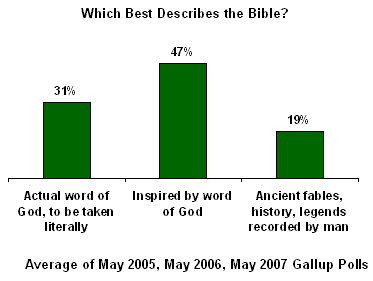

Most Americans believe in the inspiration of the Bible but not that it is the word of God, this is in spite of the long tradition of people calling it the word of God. They are still able to see past the logical fallacy of calling something the word of God when that something makes no such claims for itself, either in individual books nor of course as a combined whole. Since people had to seek out the books and through a process of church acceptance decide which books they thought belonged for use by Christians it is understandable that that assemblage of books could not make the claim to be the word of God. Which kind of explains why tradition does what logic could not do.
As we look at the list of external in internal evidence that the GotQuestions.org site gives the first question to ask is do their evidence point to inspiration or to the Bible being the word of God. How would you tell the difference? We already know the answer from the very first paragraph that GotQuestions.org uses. They won’t even consider the belief that the majority of Americans hold. Let’s look at a few examples:

One of the first internal evidences that the Bible is truly God’s Word is seen in its unity. Even though it is really sixty-six individual books, written on three continents, in three different languages, over a period of approximately 1500 years, by more than 40 authors who came from many walks of life, the Bible remains one unified book from beginning to end without contradiction. This unity is unique from all other books and is evidence of the divine origin of the words which God moved men to record.

Well unity maybe a little flimsy considering that people did put the compilation together. Jews compiled the Old Testament and Christians adding the New Testament. We won’t talk about the Apocrypha, once accepted by Protestants and now mainly accepted by Roman Catholics. But you can see the problem of claiming unity of something that was made by selecting the books that people thought assisted their religion the best. Of course, there actually are contradictions and really who can say that Ecclesiastes really agrees with the teachings of the New Testament.

That one does not work to well for being the word of God but it does work for inspiration. Because people can really pick out inspirational ideas and compile them and even when the ideas are totally different such as Ecclesiastes inspiration can be comprehended as God dealing with people where they were and stimulating ideas to create growth in understanding. It could even be termed inspiration that when we read about those people we learn what they thought about things.

We will quickly go over the next one:

Another of the internal evidences that indicates the Bible is truly God’s Word is the prophecies contained within its pages…

Again the prophecies were given to men so they speak of inspiration not the word of God, though certainly a prophet could at times actually record the words God used or the words they attributed to God. But again that does not make the entire document the word of God.

A third internal evidence of the divine origin of the Bible is its unique authority and power. While this evidence is more subjective than the first two, it is no less a powerful testimony of the divine origin of the Bible. The Bible’s authority is unlike any other book ever written.

This one does not count; the authority comes from the belief of the people involved, it is not really any kind of evidence.

There are also external evidences that indicate the Bible is truly the Word of God. One is the historicity of the Bible. Because the Bible details historical events, its truthfulness and accuracy are subject to verification like any other historical document.

How this applies to making the Bible the word of God I am not sure. That it records history is true, maybe not all the history is accurate, but a recording of history does not necessarily indicate either inspiration or being the word of God. Current events quickly become history and common knowledge can record history hundred of years after the fact or 5 years after the fact. It does not require divine inspiration for this one.

Another external evidence that the Bible is truly God’s Word is the integrity of its human authors. As mentioned earlier, God used men from many walks of life to record His words. In studying the lives of these men, we find them to be honest and sincere. The fact that they were willing to die often excruciating deaths for what they believed testifies that these ordinary yet honest men truly believed God had spoken to them.

This one actually only speaks to inspiration, not at all to being the word of God as it refers to the people who were inspired to write some things. Inspiration of course is a wide subject; something can be a very important piece of inspirational thought at a particular time and generations latter be little more than a footnote to history. A story can be inspiration to hearers even if it is not literally true. And inspiration can be found in the writers as well as the hearers where ever in time they may be.

A final external evidence that the Bible is truly God’s Word is the indestructibility of the Bible. Because of its importance and its claim to be the very Word of God, the Bible has suffered more vicious attacks and attempts to destroy it than any other book in history.

Again that would not necessarily be the case, even if the book and all its components were not the word of God it is possible for God to prevent its destruction. I am also not so sure that it has had more vicious attacks as there were certain Gnostic books which we now only read about in the writings of the Christian apologists writing against the Gnostic books. So some books were viciously and successfully wiped out. Some of those were only discovered in the 1800’s as what is termed the Nag Hammadi library, but still some are likely gone forever. In fact in the ancient world where everything was hand written it appears a lot of books were lost with the destruction of the Ancient Library of Alexandria. It may seem kind of funny but in some respects the preservation of the Bible may well be tied to the empire of Rome when they made Christianity a state religion. What some people may think as the worst thing to happen to Christianity may have been one of the methods God used to preserve the Bible.

After all the evidence is looked at we arrive back where we started. Some will look at the Bible as the word of God because that is what they choose to believe and some see the inspiration in the book but do not feel it is appropriate to call it the word of God. Rather they look for God’s revelation in the book and like any book we have to weigh the statements against reality, both history and science and cultural knowledge help us to understand more about God and ourselves and that after all is really what inspiration is all about. Because God is really able to draw us closer to Himself as we seek to understand what He is like, what love is like and what we as people are like.

Then the LORD said to Moses, "Say to the Israelites, 'You must observe my Sabbaths. This will be a sign between me and you for the generations to come, so you may know that I am the LORD, who makes you holy. "'Observe the Sabbath, because it is holy to you. Anyone who desecrates it must be put to death; whoever does any work on that day must be cut off from his people. (Exodus 31:12-14 NIV) 

How do you interpret the above verse? Is it inerrant, God said it, I believe it word of God? How you answer that question will decide your view of the Bible. Most however won’t be asked that question. They will refuse to even allow themselves to ask that question even as they read the similar verses which are also spoken as the instructions of the Lord. For example we could ask the same question of the following verse:

(Exodus 20: 22)  Then the LORD said to Moses, "Tell the Israelites this: 'You have seen for yourselves that I have spoken to you from heaven: (Exo 21:17 NIV)  "Anyone who curses his father or mother must be put to death.

Granted it is pretty nasty to curse your parents but is it deserving of being put to death? I would think most people would think of that as overkill, but what do you do when that is a command from God? Did God ever take back these commands? If He did, which I can’t find anywhere, what would that say about God? Most will say that those are just commands to the theocracy of ancient Israel they don’t apply today. Why don’t they apply today, does not the word of God stand forever, is not God the same today and yesterday? With this introduction; with it’s thought questions in mind let us look at what a couple of prominent Christian organizations say about the inspiration of the Bible. I will use two websites. The first is a study by a noted conservative Bible teacher John MacArthur Our God-Breathed Bible and the other a popular apologetics website: CARM Christian Apologetics and Research Ministry

The CARM site article would be designed to counter my first half of this article. The title in fact goes against my conclusion “The Bible isn't the word of God. It contains the word of God”, well almost as I would say it contains some of the words of God. Here is how the article begins:

One of the objections raised by critics of biblical inspiration is that the Bible is not the word of God but that it contains the word of God.  Is this accurate?  No.  First of all, this doesn't fit what the Bible says about itself.  The collection of 66 books that the Christian Church recognized as being inspired speaks as the very words of God in many places.
  1. "Thus says the Lord" occurs over 400 times in the Old Testament.
  2. "God said" occurs 42 times in the Old Testament and four times in the New Testament.
  3. "God spoke" occurs 9 times in the Old Testament and 3 times in the New Testament.
  4. "The Spirit of the Lord spoke" through people…
We should first correct the ever-present condescension that such articles use to try and persuade people who don’t read carefully. The objections are not those of critics of biblical inspiration, they are critics of the fundamentalist form of biblical interpretation. You notice by the title it is not addressed to an atheist critic because they would not hold to the part about containing words of God. So the article begins by assuming their view to be correct and it is based upon some faulty thinking because of course, the Bible does not say of itself that it is the word of God, not any particular book or the later collection of books we call the Bible makes the claim. Even the claim to the number of times the Lord is said to have said something does not make the whole Bible the word of God. But if one assumes that it does and that the whole Bible is the word of God where does that leave you when you are answering the introductory questions in this article? Much of the CARM article then goes into the claims that were already dealt with in my previous articles so we will move on to John MacArthur.
In this lesson we examine the subject of inspiration and we begin by considering the meaning of the term. The English word  Inspire is derived from the Latin  inspirare, which means "to breathe in." Second Timothy 3:16 says, "All scripture is given by inspiration of God" or, as it is translated in the New American Standard Version, "All scripture is inspired by God." The term,  inspiration, does not reflect the exact sense of  theopneustos, which is the term in our passage.  Theopneustos means "God-breathed"; the Scriptures are breathed out by God, not breathed in. So we may say that the Bible is the product of God breathing out His words so what He wanted written got written. In other words, the Scriptures are the product of divine breath assuring us that the sixty-six books of the Bible are the very words of God. 
This is the most popular verse used to claim the inspiration of the Bible thus the Bible is the word of God. It is a good verse dealing with inspiration but does not claim the Bible as the word of God. In fact when we read the whole text in its context we see that the inspiration is very broad.
But as for you, continue in what you have learned and have become convinced of, because you know those from whom you learned it, and how from infancy you have known the holy Scriptures, which are able to make you wise for salvation through faith in Christ Jesus. All Scripture is God-breathed and is useful for teaching, rebuking, correcting and training in righteousness, so that the man of God may be thoroughly equipped for every good work. (2 Timothy 3:14-17 NIV)
The scriptures are inspired to make you wise for salvation through faith in Jesus, they are useful for teaching, rebuking, and training in doing right so we can do good work. That says nothing about the Scriptures being inerrant or literally true in all statements or historically or scientifically accurate. No, it says God gave the scriptures to make us wise for salvation. God is involved in the process of helping us understand salvation; to help us understand ourselves and God better so that we could come to faith in Jesus Christ. Stories which are what most of the Bible is; are wonderful techniques for instructing with ideas of how to behave and how not to behave. What causes trouble and what gets a person out of trouble. Does a story have to be literal or historical to teach a lesson? Well of course not we know that plainly from our own experience with the books we read. Myths like George Washington chopping down a cherry tree can bring lessons out of their fiction, as we have all heard the tale and can quote fictional George Washington, “I cannot tell a lie”. Stand up and take responsibility, a powerful concept from a simple fictional story.
MacArthur later in his article states:
So the men who wrote the Old and New Testaments were commissioned by God to write His words. Paul's words to Felix reinforce the fact that we can trust the Bible as the Word of God: "This I confess unto thee that, after the way which they call heresy, so worship I the God of my fathers, believing all things which are written in the law and in the prophets" (Acts 24:14).

2. It includes all Scripture 
The Greek term  pasa can be translated "all" or "every." However, when Paul wrote 2 Timothy 3:16 the New Testament canon was not closed. Therefore some believe "all" can refer only to the Old Testament. But that interpretation places a time restriction upon "all" that is not warranted by the text. All Scripture is inspired of God whether it precedes or follows Paul's second epistle to Timothy. 

Jesus said "the scripture cannot be broken" (John 10.35). That includes Scripture that had been written, was being written, and would be written.
I really like the juxtaposition of this part of his article. MacArthur concludes one section with the quote about Paul believing all things which are written in the law and the prophets. But does he really? Think about what Paul says about circumcision.  He says several places that circumcision is nothing (1 Cor 7:19, Gal 5:6, Gal 6:15) and he even warns of those who cling to it:
Finally, my brothers, rejoice in the Lord! It is no trouble for me to write the same things to you again, and it is a safeguard for you. Watch out for those dogs, those men who do evil, those mutilators of the flesh.  For it is we who are the circumcision, we who worship by the Spirit of God, who glory in Christ Jesus, and who put no confidence in the flesh-- (Philippians 3:1-3 NIV) 
What Paul believed about the law and the prophets was much different then his ancestors believed because Paul did not hold to literal verbal inspiration of the Scriptures, he reinterpreted them in the light of his relationship with Jesus Christ. Paul writes:
Therefore, remember that formerly you who are Gentiles by birth and called "uncircumcised" by those who call themselves "the circumcision" (that done in the body by the hands of men)-- remember that at that time you were separate from Christ, excluded from citizenship in Israel and foreigners to the covenants of the promise, without hope and without God in the world. (Eph 2:11-12 NIV) 
In the Bible, we have to be very careful with the word “all” or “every”. Today educated people know that when people say “all” or “every”; they are making a generalization. Because if the use of “all” or “every” is meant to be taken literally the statement can be disproved with merely one example that contradicts the statement. The Bible actually has numerous contradictions of facts. The believer in inerrancy gets by these contradictions by saying that in the original manuscripts the errors don’t occur. This is however a faulty use of logic because the originals no longer exist so it is merely a gratuitous assertion.  
Paul tends to use “all” in the generalization way for example:
At my first defense, no one came to my support, but everyone deserted me. May it not be held against them. But the Lord stood at my side and gave me strength, so that through me the message might be fully proclaimed and all the Gentiles might hear it. And I was delivered from the lion's mouth. (2 Tim 4:16-17 NIV) 
Or consider Paul saying:
…if you continue in your faith, established and firm, not moved from the hope held out in the gospel. This is the gospel that you heard and that has been proclaimed to every creature under heaven, and of which I, Paul, have become a servant. (Col 1:23 NIV) 

The gospel had not then and probably even now been proclaimed to every creature under heaven, it is an exaggeration, an exaggeration in the Bible. As the following article says of this verse:
(2) It must be recognized as well that the passages cited above are hyperbolic in nature. The word “hyperbole” derives from a combination of two Greek terms that signify “to throw above.” A hyperbole, then, is a figure of speech that contains an obvious exaggeration (with no intention of duplicity) for the purpose of emphasizing a truth. The Bible abounds with this figure, which, in most contexts, is perfectly obvious and draws no criticism.

For example, it was said of the pagan peoples east of the Jordan that “their camels were without number, as the sand which is upon the sea shore for multitude” (Judges 6:5; cf. 1 Samuel 13:5). That’s a lot of camels for a few Bedouin tribes!

Jehovah promised Abraham that his “seed,” i.e., offspring, would be “as the dust of the earth,” i.e., numberless (Genesis 13:16; cf. Galatians 3:29). But the earth could not possibly contain as many people as there are specks of dust upon the planet. This is obvious hyperbole. http://www.christiancourier.com/articles/929-was-the-gospel-preached-throughout-the-whole-world-in-the-first-century
As with all information the Bible calls for interpretation and the presuppositions with which we come to the Bible will either make us see it for what it is and derive the important principles or they will call us to make unrealistic claims about how the book came to be and how it must be interpreted. As a final example this is what MacArthur says about the exegesis of the Bible:
Many seminaries and churches teach that God gave thoughts and not specific words to the writers of Scripture. This would mean, for example, that when Paul wrote 1 Corinthians 13 the only thing God gave to Paul was some general thoughts on the subject of love. The words of the text we owe to Paul. This view is sometimes referred to as thought or concept inspiration.

Now this position denies not only verbal inspiration, but inerrancy as well. Of course that makes exegesis futile. There would be no reason to do a word-by-word exposition if you're convinced that the words are merely human and not divine.
This is, as with most of the fundamentalist approaches to the Bible foolish. First the Bible was written in one of three languages and when translated the words used translate into various English words and even in the original language one word could have multiple meanings. But this is what verbal inspiration beliefs lead to and the confusion multiplies by all of these various assertions which are incorporated into the Bible to become the presuppositions fundamentalists and traditionalist use to interpret the Bible. There comes a time when we need to realize that we have to be reasonable in our approach to the Bible and see that it does exaggerate and make claims that cannot possibly be true. That even the perception of God changes through it pages as people learn more and knowledge increases. We can’t go back to the primitive concepts and literalism that was once used to understand the Bible. And yes it calls for human intelligence and reason and understanding just as everything else in life calls for us to think. That is not a bad thing however, and let’s be glad that even though in the stories God called for rather nasty things we don’t have to carry them out as if they are the enduring word of God that never changes because really otherwise we would all have to end up killing each other just over our breaking the Sabbath. The subject of keeping the Sabbath reminds us of the old Jewish prophecy which as quoted in this article
"Rabbi Judah said in the name of Rav: If all Israel had observed the very first Sabbath, no nation or tongue would have ever ruled over her…Rabbi Yohanan said, following Rabbi Simeon bar Yohai: Were Israel to observe two Sabbaths punctiliously, they would be redeemed immediately [BT Shabbat 118b]." MyJewishlearning.com